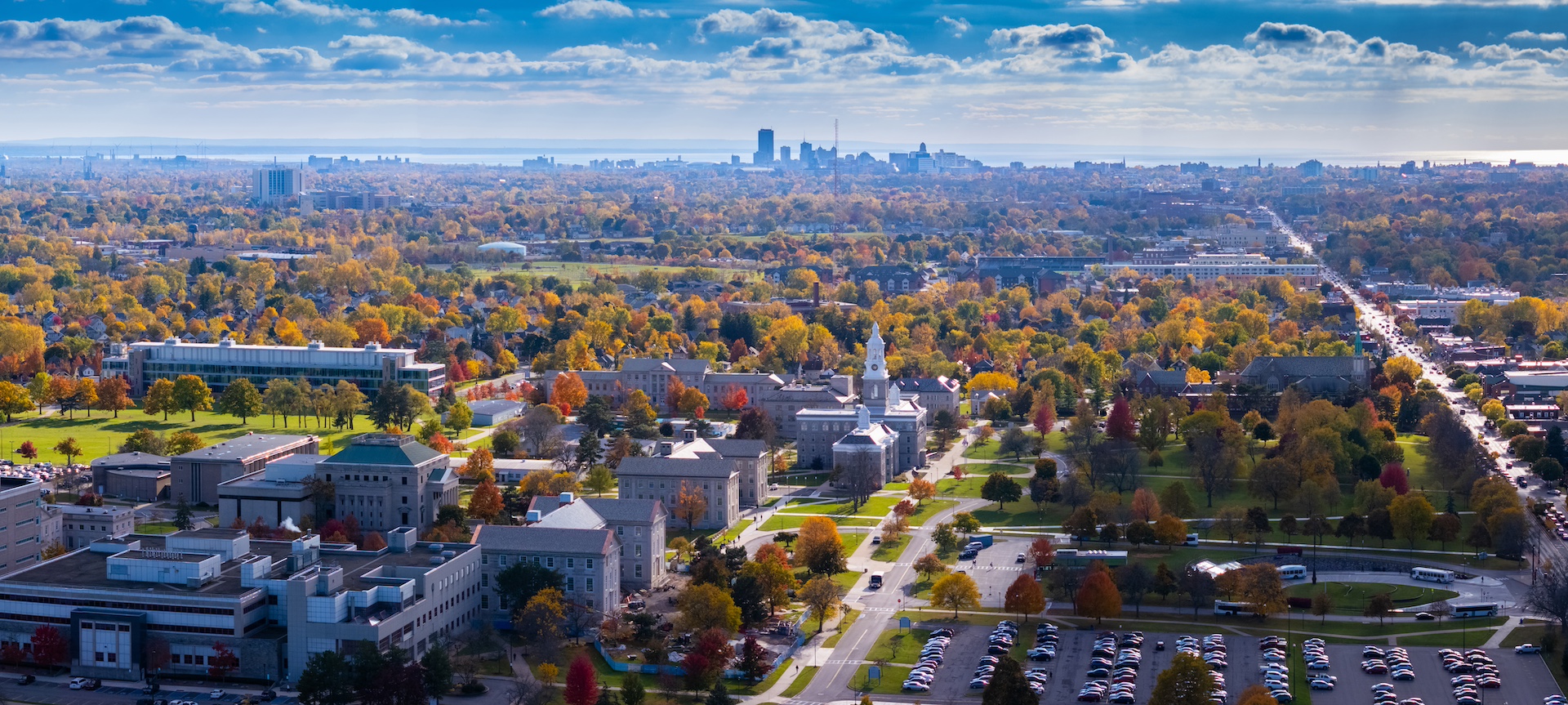
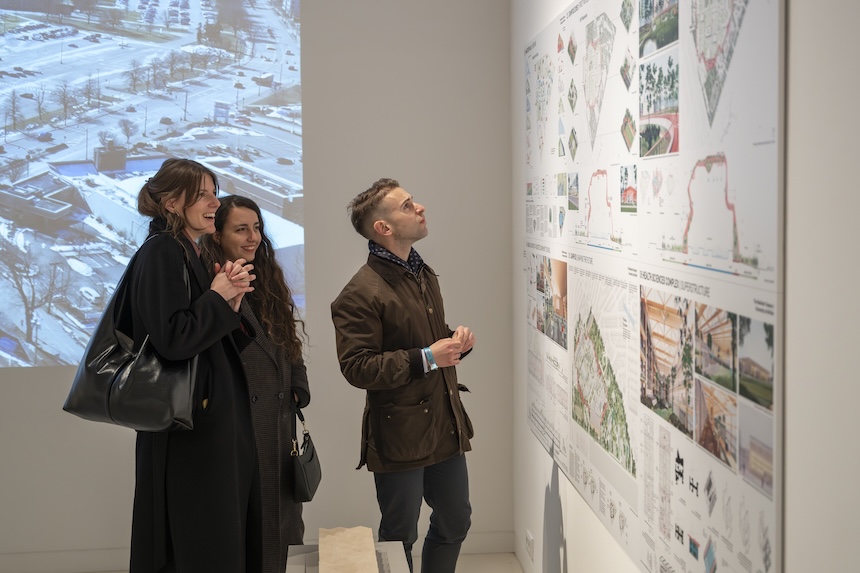
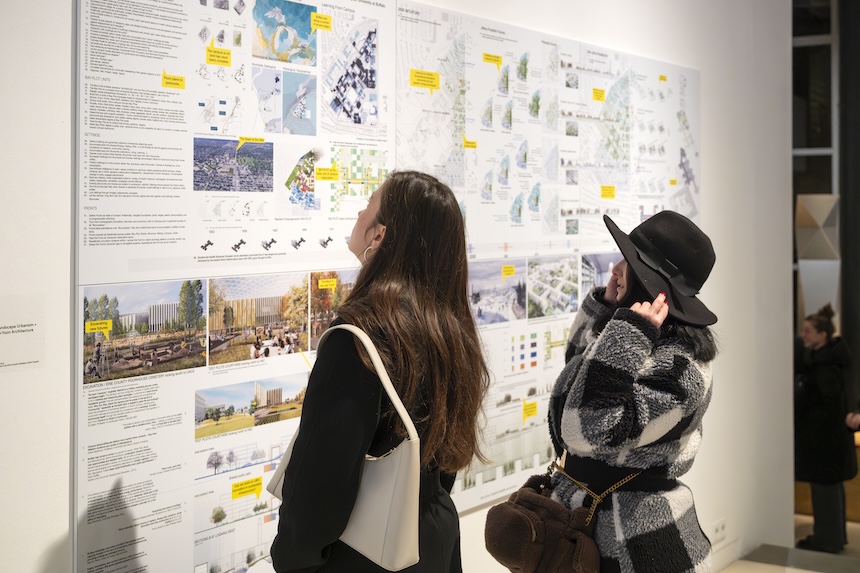
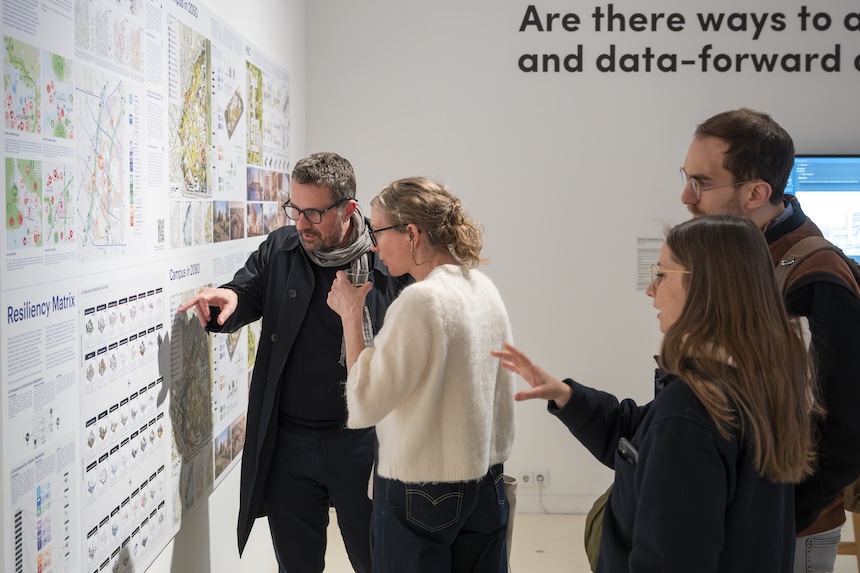
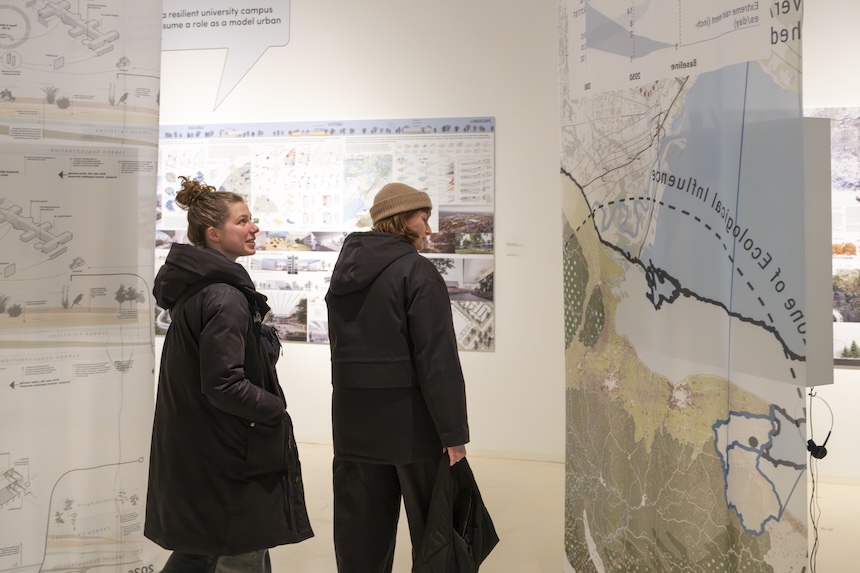
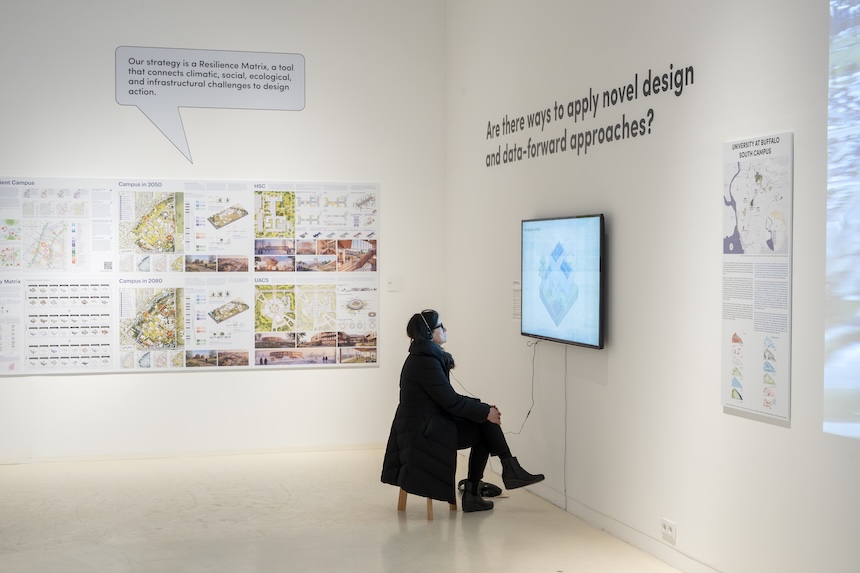
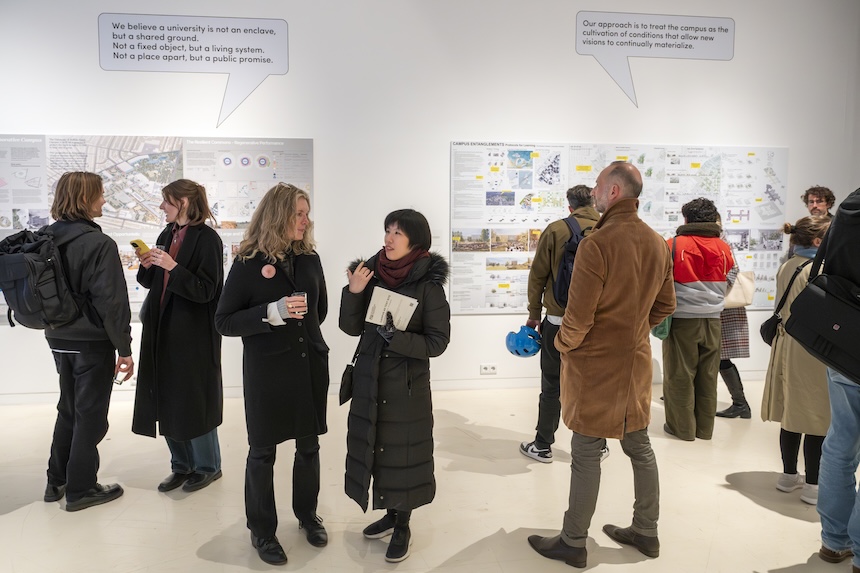
Climate change and its attendant crises are fundamentally reshaping how we design, inhabit and sustain our built environment and its living landscapes. In a planetary polycrisis – where ecological, social and infrastructural risks are deeply interconnected – traditional disciplinary approaches prove insufficient. Design must work across scales and integrate systems. Using the University at Buffalo’s South Campus as a test site, Designing for Resilience presents the work of seven international design teams. Together, they envision and visualise future scenarios for the time horizons of 2050 and 2080, based on a set of assumptions about our world. By focusing on South Campus as a forward-looking academic environment, the project develops strategies that are broadly applicable to design disciplines and professions, inviting viewers to engage with, evolve and extend these approaches elsewhere.
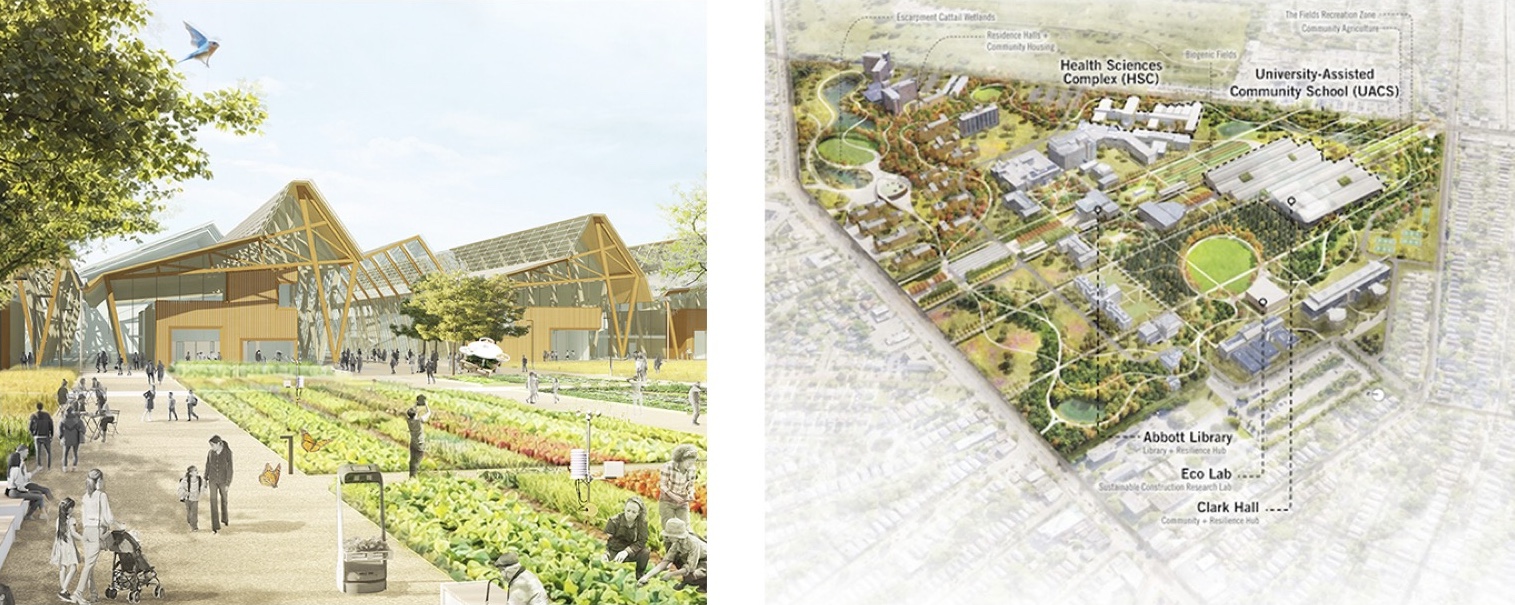
2080 Biogenic Fields | 2080 Campus aerial perspective © LTL Architects + Nelson Byrd Woltz Landscape Architects + Derive Engineers
A competition for a new campus
In the spring of 2025, the University at Buffalo School of Architecture and Planning (UB SAP) launched a two-stage international design competition called The Resilient Campus. Like many North American higher-education campuses, UB's South Campus is in constant evolution: adapting to teaching and research needs, uncovering and celebrating layered histories and fostering diverse academic communities. As such, South Campus is a highly representative example of American college campuses. Until now, in its Great Lakes setting, it has not yet been vulnerable to extreme weather events such as flooding, drought or fire. Addressing resilience and adaptability in this context can generate transferable insights for rethinking campus environments at large.
The teams selected in the competition – whose work is featured here – were challenged to foreground resilience and sustainability, understood as related but distinct concepts that address different dimensions of a living system's capacity to thrive and flourish. Within the framework of the project, resilience is defined as a complex socio-ecological system's ability to withstand, adapt to, recover from – and, when necessary, transform in response to – shocks and disturbances. Sustainability, long a central focus of campus and design practice, is therefore framed as a prerequisite for resilience in the face of climate change, emphasising the need to meet present demands without compromising the ability of future generations to meet their own.
This competition work explores speculative scenarios for campus landscapes and buildings, envisioning more reciprocal relationships between the built and living environments. Through this approach, it seeks to advance, disseminate, and promote transdisciplinary and transformative knowledge on designing for resilience.
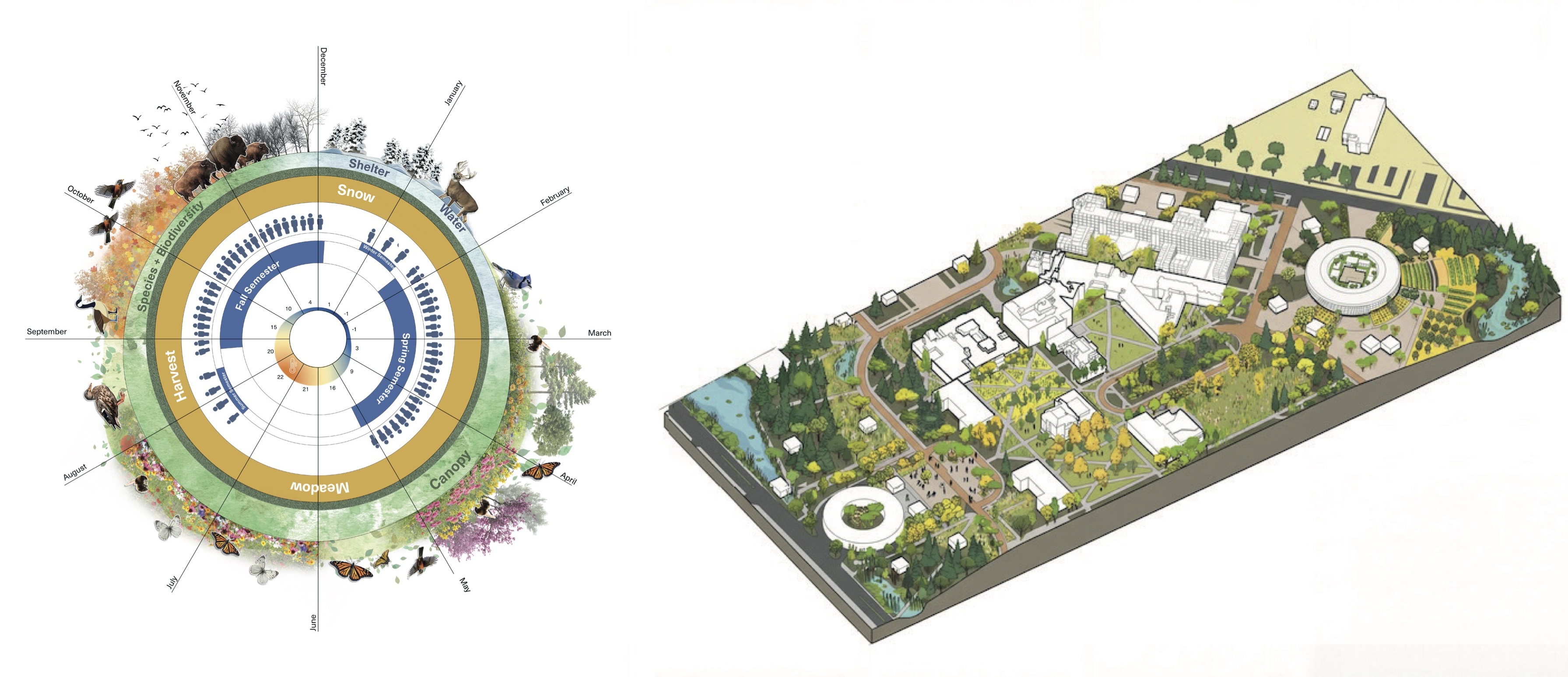
Future State © ASPECT Studios + Woods Bagot Architecture + Dr. Jillian Walliss | Campus transect 2080 © MVRDV + RIOS
Participating Teams
• ASPECT Studios + Woods Bagot Architecture + Jillian Walliss
• Barkow Leibinger + TOPOTEK1 + Transsolar KlimaEngineering + Guy Nordenson and Associates
• LTL Architects + Nelson Byrd Woltz Landscape Architects + Derive Engineers
• MASS + EinwillerKuehl + SITELAB Urban Studio + Second Nature Ecology and Design
• MVRDV + RIOS
• OBRA Architects + LOLA Landscape Architects
• STOSS Landscape Urbanism + Höweler Yoon Architecture
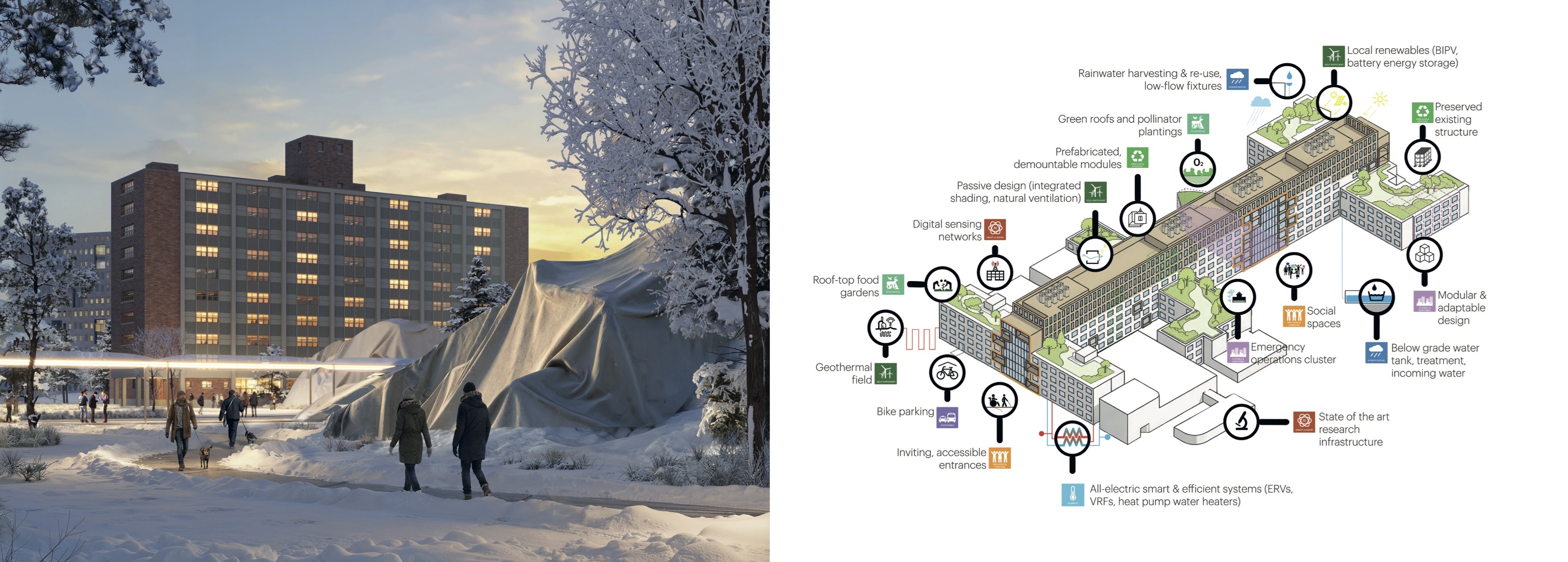
Winter landscape © OBRA Architects + LOLA Landscape Architects | Health science complex, strategies © MVRDV + RIOS
ABOUT THE EXHIBITION
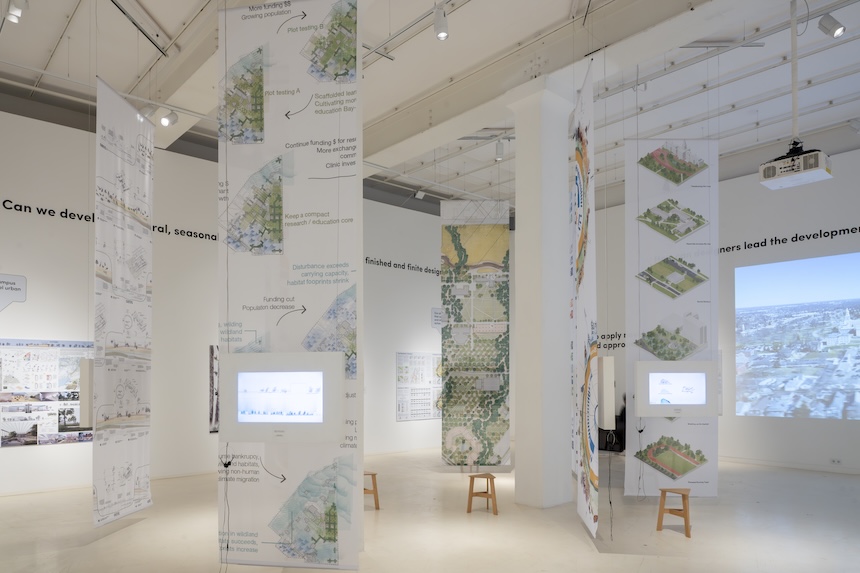
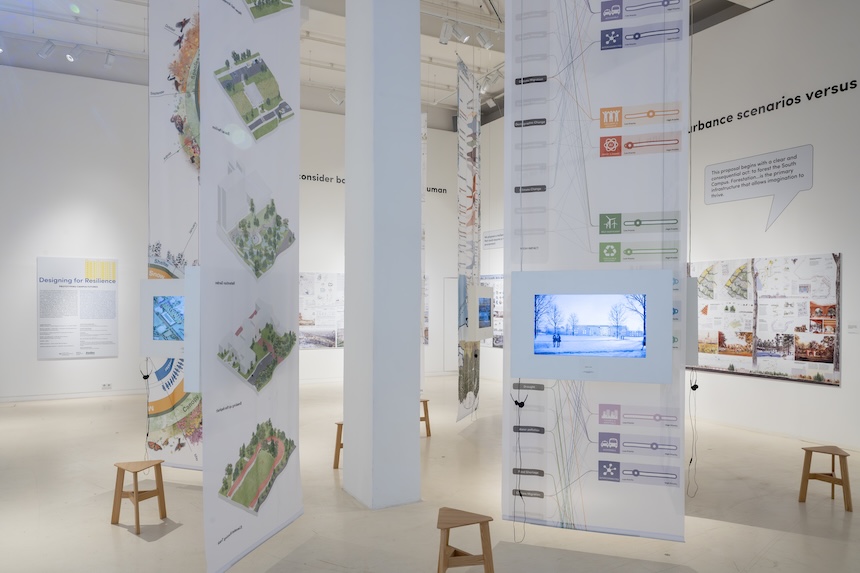
Designing for Resilience presents seven distinct approaches to strengthening the resilience of the university campus. Each approach articulates a specific philosophy of resilience and translates it through diagrams, images, timelines, perspectives and analysis of a changing environment. These unique studies illustrate how the campus environment evolves under different conditions and interventions, supported by a short video from each team.
Sponsor
University at Buffalo School of Architecture and Planning with assistance provided by the University at Buffalo’s Graduate School of Education, Office of Sustainability, and University Facilities